Understanding audiences
Making advertising accessible to everyone benefits us all. Accessibility is a large spectrum and includes a variety of individuals from being born with a disability to experiencing disability later in life. At some point, it is highly likely that we (or someone we know) will have the need for accessible products and services or have the need for accessibility day to day.
Research audiences in your local market to understand the potential impact and reach of your advertising accessibility efforts.
Building the case for your business
Accessible advertising is important as we look to effectively reach all consumers. Features such as audio description and captions allow those who rely on access services to experience your brand communication as intended.
15% of people have disabilities, and your advertising will be playing out to these consumers regardless of whether the assets were developed with accessibility in mind.
Accessible advertising reduces the risk of wastage within your existing media buy because you reach a greater proportion of consumers with your brand messaging as intended. Accessible advertising is critical where aiming for 100% effective reach.
Also consider your consumers and target audiences and look at their characteristics. You may find that certain groups over-index on access needs, and highlighting these aspects can help bolster your business case and identify where your business can make a big impact.
Accessibility is a shared responsibility.
It's a responsibility for everyone engaged in the process of creating and delivering advertising to the public, including brands, agencies, production companies, media companies and platforms.
Vital work is being undertaken by key industry changemakers participating in the Ad Accessibility Network, convened under the auspices of the World Federation of Advertisers (WFA). The UK’s Incorporated Society of British Advertisers (ISBA) and France’s Union des Marques (UDM) have been acting as lead markets to generate learning and experience that can be translated into guidance and playbooks for other markets.
Acknowledgements
Contributors
Contact us
Resources for faster progress
Below we've provided some reference guidance, case studies and potential suppliers who can help on your journey.
Captions (Subtitles)
Captions, or subtitles, are time-synchronised text displayed at the bottom of the screen that transcribe the on-screen dialogue and key sounds or music. Beyond dialogue, these other sound elements help convey the mood and atmosphere in the ad.
In addition to providing access for the deaf or have hearing loss, they are also enjoyed regularly and often preferred by many people who do not have auditory disabilities.
Captions can be closed, where consumers can turn them on and off, or open, where they are permanently embedded for everyone. Open captions are sometimes referred to as 'burnt in.'
Remember to ensure they are legible with high contrast to the background, precise, synched to the audio, delivering a steady reading pace and not obstructing any important information.
Many digital platforms provide automatically generated captions, but you'll need to verify the accuracy of them.
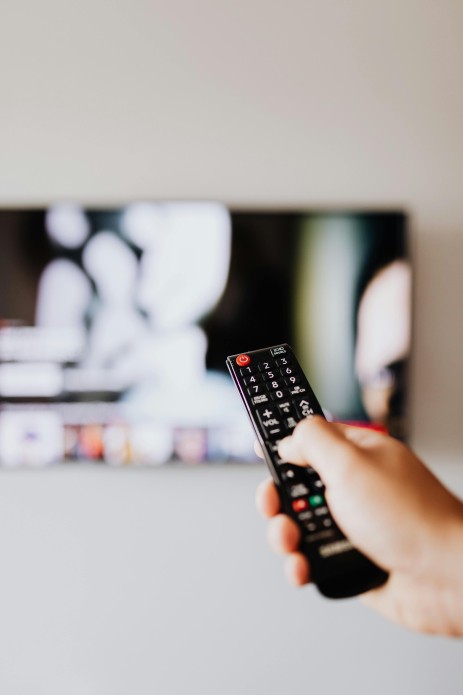
Photo by Karolina Grabowska for Pexels
Audio Description
Audio Description is a form of voiceover narration that is played in parallel to the ad's main audio track, with narration in the gaps between dialogue. It describes the most important on-screen visuals, ensuring the meaning and narrative of the ad is delivered via sound to those who are blind or have low vision. For example, it could include details like body language, expressions and movements that are important to the story.
In media placements that support it, Audio Description is toggled on and off by consumers who want to use it. However, it's also possible to choose to have the audio description permanently played to everyone by making it part of your ad's main script.
Tip: Check with your local clearance organisation to understand if your claims and supers (on-screen text) will need to be included in your audio description voiceover, so that you can plan accordingly.

Photo by RDNE Stock Project for Pexels
Audio-led Storytelling
This technique involves integrating descriptive elements directly into the script, such that it doesn't require an additional audio description track to convey its meaning. This involves weaving the audio description elements directly into the creative content. You can think of the storytelling process as being similar to a radio ad, where it must communicate clearly without the use of visuals.
Unlike traditional audio descriptions, which are produced and added at a later stage, integrated audio descriptions are part of the original production process. The result is that the story naturally conveys the necessary visual information, allowing all viewers to understand and enjoy the content equally - this is referred to as 'accessible by design'.
Colour Contrast
Colour Contrast is a critical consideration in visual assets, especially for individuals with colourblindness, where certain colour combinations can be difficult to distinguish. Adequate contrast ensures that text and important visual elements stand out against their backgrounds, making the content more legible and discernable.
By adhering to colour contrast guidelines and using tools to check contrast ratios, designers can create content that is distinguishable. Remember to also avoid using colour alone to communicate meaning.
You can find detailed information about colour contrast guidelines on the Web Content Accessibility Guidelines website.
Start with captions
If you do nothing else, add captions.
They can be toggled on and off by the consumer, so you don't need to change your key visual; and those without captions on won't see them.
It's simple to request captions in your campaign brief and you may find your creative partners are already making them as part of their existing process.
Whether it's for TV or digital, captions are delivered in a similar way, with each having a slightly different file format. When you're running a campaign across TV and digital, it isn't difficult for your creative partners to adjust captions made for one placement to work for the other.
Adding captions is low cost, but can enable you to reach the large audience of people who are deaf or have hearing loss as well as the many people who prefer to consume content with captions.
Photo by Karolina Grabowska for Pexels